


Source: BioWorld | 2024-08-01 09:31
Synthetic biology requires the development of more mature theoretical and methodological frameworks to guide the rational design of biological systems—it is essential for the field to advance toward the new level of quantitative synthetic biology.
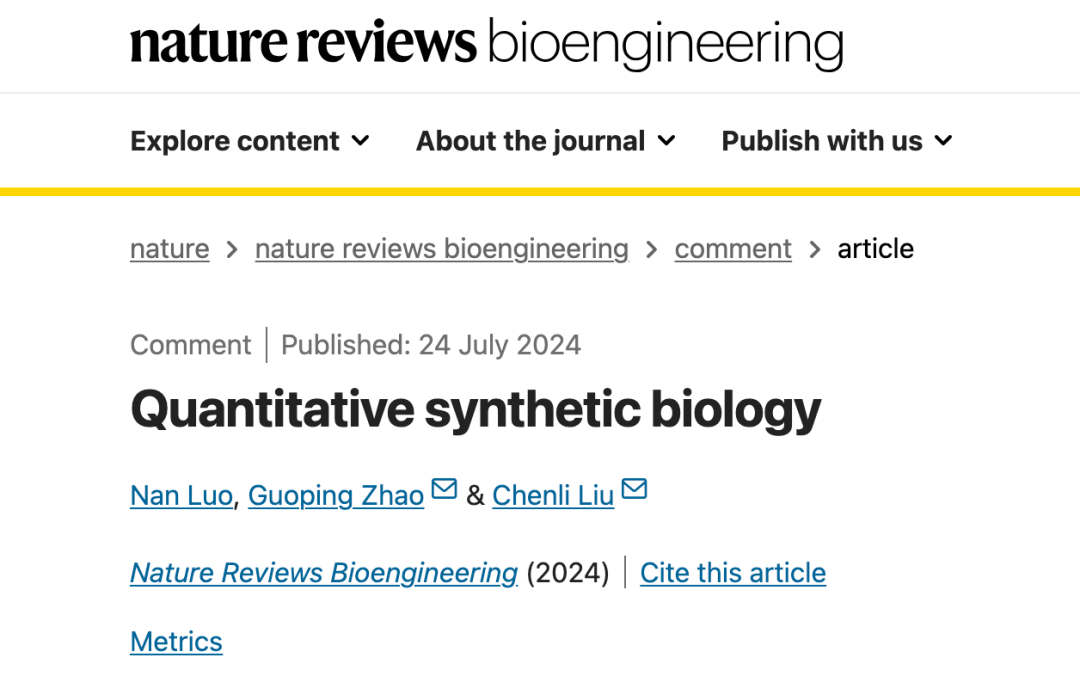
Researcher Liu Chenli from the Shenzhen Institute of Advanced Technology, Chinese Academy of Sciences, and Researcher Zhao Guoping from the Center for Excellence in Molecular Plant Sciences, Chinese Academy of Sciences, have published a review titled "Quantitative Synthetic Biology" in Nature Reviews Bioengineering, a journal under the Nature portfolio. This article is the first to elucidate the research paradigm and disciplinary connotation of this new field internationally, proposing directions for the next phase of synthetic biology development.
Synthetic biology is becoming a powerful engine driving next-generation biomanufacturing and the bioeconomy. Over the past two decades, with continuous innovations in DNA synthesis and gene editing technologies, the capability to construct synthetic biological systems has rapidly improved. However, the foundational design capacity remains limited. Due to the complexity of biological systems, even when the functions of individual components are known, their combination does not necessarily yield the expected system-level behavior. To rationally design synthetic systems with specific functions, a deep understanding of the principles underlying functional emergence in natural systems is required—an aspect rarely addressed in synthetic biology research to date.
Currently, most synthetic biological systems are constructed through manual trial and error—a slow and inefficient process that significantly hinders the advancement of synthetic biology. Thus, one of the major challenges in synthetic biology is how to enhance rational design capabilities. Only when design and synthesis capabilities are effectively coordinated—where synthesis validates design, and design guides synthesis—can a "design-build-test-learn" cycle be established, enabling reliable and efficient construction of more sophisticated biological systems.
Therefore, synthetic biology needs to develop more mature theoretical and methodological frameworks to guide the rational design of biological systems—it must rise to the new level of quantitative synthetic biology. The authors propose that rational design is essentially prediction-based design. When biomolecules, genes, and circuits are combined into a synthetic biological system, the ability to accurately predict the system’s behavior and function allows researchers to foresee how to construct the system to achieve the desired outcome, thereby avoiding repeated trial and error.
The authors summarize three research paradigms for achieving rational design in quantitative synthetic biology:

Figure 1: Three Research Paradigms in Quantitative Synthetic Biology
1. Principle-Based Design (Fig. 1a)
Rational design requires models capable of precise system prediction. Typically, models abstract the internal mechanisms of biological systems, helping to understand the logical architecture (topology) behind functions. For relatively simple biological functions, well-established theoretical models exist. Thus, many early classic works in synthetic biology adopted this "top-down" paradigm: first, mathematical models are developed to explore the principles of functional emergence, identifying the topological structures that yield target functions; then, specific biological components are designed based on these structures.
2. Bottom-Up Design (Fig. 1b)
As synthetic biology advances, systems have grown increasingly complex, making "top-down" design highly challenging. Consequently, many studies have adopted a "bottom-up" strategy. This approach starts with components and initially involves trial and error—exploring possible functions by testing different assembly methods. While "serendipitous" discoveries of interesting functions may occur, quantitative synthetic biology begins at this stage: once a system with the expected function is obtained, its known components allow inference of the topology, enabling the construction of mathematical models and validation through synthetic systems to elucidate functional principles. Unexpected functions emerging during synthesis—often overlooked in traditional synthetic biology—can guide the discovery of new principles in quantitative synthetic biology. Understanding these principles enables the design of synthetic systems with similar or more complex functions. The emergent principles discovered often apply to both natural and synthetic biological systems, thereby advancing fundamental life sciences.
3. AI-Assisted Design (Fig. 1c)
Advances in artificial intelligence (AI) offer new pathways for quantitative prediction of biological systems. AI-based algorithms do not require understanding the internal workings of biological systems but instead identify hidden patterns between components and functions through large-scale data analysis, predicting how to design components to achieve specific functions. This paradigm relies on vast amounts of high-quality, standardized data. Thus, future synthetic biology will require automated, high-throughput equipment platforms and standardized experimental methods.
Currently, there is a global surge in the establishment of automated biofoundries, which use automation technology to efficiently construct and test synthetic biological systems. These facilities not only provide AI with standardized, quantitative, large-scale data generated through machine-automated experiments (free from human operational errors) under guided system design (including essential controls), enabling rapid "design-build-test-learn" iterations to achieve target functions, but also enhance the quality of trial-and-error in Paradigm 2, facilitating the discovery of new principles through machine learning on high-quality big data.
All three design paradigms emphasize close integration with quantitative analysis methods, using mathematical logic and quantitative relationships to make predictive assessments of biological systems, thereby providing a foundation for rational design of synthetic biological systems. Thus, the authors propose quantitative synthetic biology as a developmental direction for the field. Quantitative synthetic biology incorporates the thinking and methods of quantitative biology and systems biology, establishing mathematical or AI models capable of quantitatively predicting biological systems to guide the design and construction of synthetic systems, thereby addressing the bottleneck of "rational design" in synthetic biology. Advancing quantitative synthetic biology will transform the field from qualitative, descriptive, and fragmented research to quantitative, theoretical, and systematic studies. Simultaneously, it will deepen fundamental understanding of life systems and the principles governing their design, elevating synthetic biology from an engineering discipline to a driving force for basic biological science. The synergistic progress between fundamental life science research and synthetic biology will truly open the door to a revolution in life sciences research while guiding the development of new-generation biotechnology and engineering biology.
Researcher Liu Chenli from the Shenzhen Institute of Advanced Technology, Chinese Academy of Sciences, and Researcher Zhao Guoping from the Center for Excellence in Molecular Plant Sciences, Chinese Academy of Sciences, are the corresponding authors. Assistant Researcher Luo Nan from Liu Chenli's team is the first author. This work was supported by multiple projects from the National Natural Science Foundation of China.
Development Timeline of Quantitative Synthetic Biology
2017: The Shenzhen Institute of Advanced Technology, Chinese Academy of Sciences, established the Center for Quantitative Synthetic Biology, first proposing the interdisciplinary concept of quantitative synthetic biology.
2020: The center was approved as a CAS Key Laboratory and Cross-Disciplinary Innovation Team in Quantitative Engineering Biology.
2021: China hosted the Xiangshan Scientific Conference on Quantitative Synthetic Biology. 2023: The Shenzhen Institute of Advanced Technology was approved to establish the CAS Key Laboratory of Quantitative Synthetic Biology.
Throughout this journey, the new direction of quantitative synthetic biology has gradually gained recognition and attention from peers. Journals such as ACS Synthetic Biology, Quantitative Biology, Science Bulletin, and Synthetic Biology have published special issues on "Quantitative Synthetic Biology." The 2024 SEED Conference specifically included a workshop on "Modeling and Quantitative Synthetic Biology," while international research institutions such as Duke University (USA) and TIGEM (Italy) have also begun initiatives in "Quantitative Synthetic Biology."
Copyright Statement: All content labeled "Source: BioWorld" or "Source: bioon" is the property of the BioWorld website. Unauthorized reproduction by any media, website, or individual is prohibited. Legal responsibility will be pursued for violations. When authorized reproduction is granted, the source "BioWorld" must be credited. Reprinted articles from other sources are intended to convey more information; the views expressed do not represent the site’s立场. Media or individuals who do not wish to be reprinted may contact us for immediate removal.